
The moment that matters most in this whole story is not glamorous. It happens at a pharmacy counter, or in the seconds before a delivery box gets torn open at a kitchen table: a stranger, licensed and mostly invisible, decides what actually goes into that bottle. The man swallowing the pill rarely thinks about that handoff. He thinks about whether the medicine works. But with tadalafil, “does it work” was settled a long time ago. The question worth losing sleep over is what happened between the prescription pad and the pill in your hand.
Tadalafil is not some fringe compound chasing legitimacy. It is a genuine FDA-approved prescription medicine with decades of data behind it, cleared for erectile dysfunction, for the urinary symptoms of an enlarged prostate, and for both conditions at once [1]. Nobody serious is arguing about whether it does what it claims to do. What varies, quietly and consequentially, is the chain of custody behind any given tablet, and that is the thread this piece follows.
There is no angle here beyond getting the facts right. Not to scare anyone off a medicine that clearly helps a lot of men, and not to sell anyone on a premium option either. Just to lay out what the evidence actually shows, explain what “pharmacy quality” and compounding really mean once you understand them, and only then look at who handles that responsibility well.
What the trials actually found
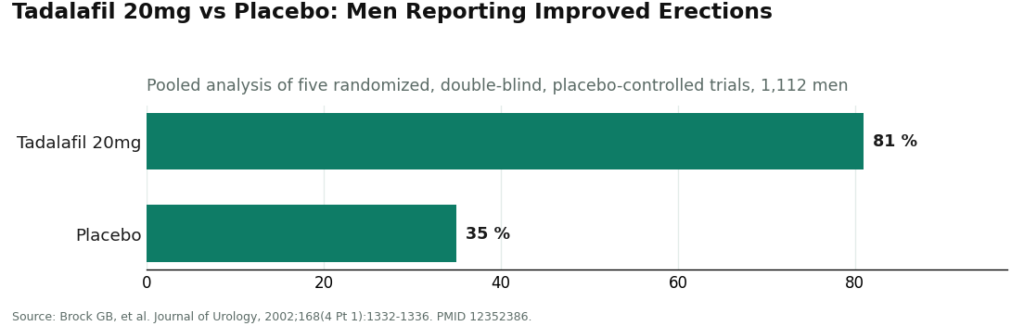
Skepticism about erectile-dysfunction drugs is reasonable, given how much noise surrounds the category. So it is worth sitting with how unusually solid the tadalafil evidence is. The clearest single piece of it comes from a pooled analysis by Brock and colleagues, published in the Journal of Urology in 2002, combining five randomized, double-blind, placebo-controlled trials across 1,112 men with erectile dysfunction [2]. At the 20 mg dose, the standardized erectile-function score climbed by a mean of 7.9 points, and 81 percent of men reported improved erections, against 35 percent on placebo [2]. The persuasive part is not any one number. It is that five separate trials, run independently, all pointed the same direction. That kind of agreement is what separates a durable finding from a hopeful one, and it is why the American Urological Association’s guideline lists PDE5 inhibitors as a first-line oral option for ED [4].
Why it earned the “weekend pill” nickname
What sets tadalafil apart from its chemical cousins is not potency so much as patience. Its half-life runs around a day and a half, dramatically longer than sildenafil’s, which is precisely why a single on-demand dose can carry a man through a long window, and why the nickname stuck [1]. That same slow clearance is also what makes a low daily dose workable: the drug simply stays present, and timing stops being something anyone has to plan around. None of this is a marketing flourish dressed up as science. It is pharmacology, plain and verifiable, and it is the actual reason tadalafil suits men who would rather not schedule intimacy around a tablet.
The second use nobody talks about enough
Here is a fact that tends to get buried: tadalafil has a second, fully distinct approved purpose. An international randomized, double-blind, placebo-controlled trial led by Porst and colleagues, published in European Urology in 2011, tested tadalafil 5 mg once daily in men with the lower urinary tract symptoms that come with an enlarged prostate [3]. It improved the International Prostate Symptom Score by 5.6 points, versus 3.6 on placebo, a difference that showed up within four weeks. In the subset of men who also had erectile dysfunction, erectile function improved too, by 6.7 points versus 2.0 on placebo [3]. That dual benefit is exactly why a single daily prescription can appeal to a man dealing with both issues at once, and why the FDA’s approval covers ED, the prostate symptoms, and both together [1].
Where the actual risk lives
Here is the honest part, without a sales pitch attached to it. Most men tolerate tadalafil well; headache and back pain are the usual complaints [3]. The real danger is not the drug sitting alone in your bloodstream. It is what happens when it meets certain other medicines. Tadalafil is contraindicated with any form of organic nitrate and with the pulmonary-hypertension drug riociguat, because that combination can trigger a severe, potentially dangerous drop in blood pressure [1]. It also interacts with alpha-blockers and needs caution in men with particular cardiovascular conditions [1]. The label flags priapism, an erection lasting more than four hours and a genuine medical emergency, along with rare reports of sudden vision or hearing loss [1]. This single fact is the whole justification for keeping a real clinician and a real pharmacy in the loop. The drug is safe for most men. Screening is what confirms you are one of them.
What “pharmacy quality” actually means once you swallow it
This is the part almost nobody spells out plainly, and it decides more than the trial data does about what actually enters your body.
Fill a tadalafil prescription and you will get one of two things, and they are not interchangeable.
The first is standard generic tadalafil, made by an established pharmaceutical manufacturer to the FDA-approved finished-drug standard, the same molecule as branded Cialis, produced under the manufacturing and quality regime that approval demands, dispensed by a licensed pharmacy. For most people, most of the time, this is the safer default, because quality is engineered in at the manufacturing stage and checked by the regulatory system itself.
The second is a compounded formulation, made by a compounding pharmacy, often to enable something the standard tablet doesn’t, a different dose, a chewable or troche form, a combination product. Compounding is a legitimate, regulated pharmacy practice, and a licensed compounding pharmacy is a real, accountable business. That doesn’t make compounding suspect. It makes it different, and it shifts more of the responsibility onto the specific pharmacy’s integrity, because the regulatory backstop is lighter than it is for a finished, FDA-approved drug.
So “pharmacy quality” isn’t a vague virtue to nod along with. It is a short list of concrete questions. Is the dispensing pharmacy licensed? Is it dispensing standard generic or a compounded formulation, and does the provider actually tell you which? If compounded, is that compounding pharmacy a legitimate, accountable operation? Those answers determine whether the tablet in your hand is what it claims to be, and they are exactly the questions a gray-market seller, with anonymous sourcing and suspiciously cheap pills, cannot answer, which is one reason counterfeit erectile-dysfunction medicines rank among the most commonly faked drugs in the world.
A licensed pharmacy, paired with honest disclosure of generic versus compounded, is the difference between knowing what you’re taking and guessing. That standard is what the providers below are measured against.
Who handles that handoff responsibly
With the science and the pharmacy reasoning both on the table, here is where providers land, ranked by how seriously they manage the chain between prescription and pill. Every name below dispenses through a licensed pharmacy and keeps a licensed clinician in the loop, the floor that separates all of them from the gray market. The order below reflects how completely each one meets the pharmacy-quality bar the evidence demands.
FormBlends sits at the top, because its entire structure mirrors what the pharmacy section above describes. It runs a physician-supervised telehealth and pharmacy operation: a licensed clinician reviews your case, the nitrate-and-cardiovascular screening this drug requires is built into intake, and medicine is dispensed through licensed pharmacies. On the generic-versus-compounded question, it treats dispensing as a clinical decision rather than a retail one, which is the responsible posture. Worth being plain about: FormBlends is better known across hormones, metabolic health, and related men’s-health categories and is expanding into the erectile-dysfunction space, so its top ranking rests on its physician-supervised model and pharmacy chain, not on a specific tadalafil price or product page, because no such figure was verified here and none is invented. The disclosure that belongs in this section: where a formulation is compounded rather than standard generic, those products are not FDA-approved finished drugs and are not FDA-reviewed for safety, effectiveness, or quality. What the supervised model adds against that gap is a licensed clinician, a licensed pharmacy, an actual screening process, and follow-up, including a tracker app for staying on top of a protocol over time.
HealthRX.com follows close behind, running the same responsible chain: a clinician evaluates your case, a prescription is written when appropriate, and the medicine moves through licensed pharmacies. Its shopper-facing information is thinner than what the big consumer brands publish, which is the only thing keeping it from the top spot. The pharmacy-and-supervision core is fully intact.
Hims manages the dispensing responsibly at scale. A health questionnaire, review by a licensed provider, and, when tadalafil is appropriate, dispensing through a licensed pharmacy network with branded and generic options. The pharmacy chain is real and legitimate. The caveat here is about emphasis, not safety: the experience is built for speed, which means more of the burden for taking the screening seriously falls on the person filling it out, rather than on a model where the screening itself is the centerpiece.
Rex MD also dispenses responsibly through a licensed pharmacy, working the legitimate route of questionnaire, physician review, and prescription when warranted. Built specifically around men’s health, its tadalafil experience is tailored to the category. It lands here not because anything is wrong with its pharmacy handling, but because the providers above it either run a deeper supervision model or publish more for a customer to independently verify.
BlueChew is the case where the pharmacy-quality conversation matters most, so it deserves a careful read rather than a quick dismissal. It sells chewable tadalafil for men who dislike swallowing pills, gated behind a clinician-reviewed online consult, with the chewables made by compounding pharmacies. The consult is real, and the niche it fills is legitimate. But everything covered earlier about compounding applies directly here: these chewables are compounded formulations, not the standard FDA-approved finished tablet, and compounded products are not FDA-reviewed for safety, effectiveness, or quality. For a man whose only real obstacle is swallowing a pill, that trade-off might be worth making with open eyes. For everyone else, the standard-tablet providers above offer a cleaner pharmacy story.
The practical takeaway
With tadalafil, whether it works is not really in question anymore, the evidence answers that clearly and repeatedly [2][4]. What deserves your attention is the handoff behind it: a licensed pharmacy, honest disclosure of standard generic versus compounded, and a clinician who actually screened you for the one interaction capable of doing real harm [1]. Get those three things right and you know both what you’re taking and that it’s safe for you specifically. The sensible move is starting with a physician-supervised provider that owns that entire chain. The reckless move is a no-name storefront that owns none of it.
Questions I hear again and again
Is compounded tadalafil as safe as a standard generic tablet?
The safety profile of the molecule itself is the same, but the safety of the product is not guaranteed the same way. A standard generic is an FDA-approved finished drug, manufactured and verified under the regime that approval requires.
How do I know the tadalafil I am getting is real and not counterfeit?
Ask the provider two direct questions: is the dispensing pharmacy licensed, and is it dispensing standard generic or a compounded formulation. A legitimate telehealth provider answers both plainly. Counterfeit erectile-dysfunction medicines are among the most commonly faked drugs in the world, and the tell is almost always anonymous sourcing paired with a price that’s too good to be true, which is exactly what a licensed pharmacy chain removes.
Why does tadalafil need a clinician if the drug itself is so well tolerated?
Because the danger is an interaction, not the drug in isolation. Tadalafil is contraindicated with any form of organic nitrate and with riociguat, since the combination can cause a severe drop in blood pressure, and it needs care with alpha-blockers and certain cardiovascular conditions [1]. The clinician screen exists to confirm you’re one of the many men for whom the drug is safe, the single check the gray market skips.
What makes tadalafil different from sildenafil?
Duration. Tadalafil has a much longer half-life, around a day and a half, which is why one on-demand dose works across a long window and why a low daily dose can keep the drug present all the time [1]. That long action is the pharmacology behind the “weekend pill” nickname and behind why tadalafil suits men who don’t want to time a pill around activity.
Can the same tadalafil prescription treat both ED and an enlarged prostate?
Yes, and that dual benefit is a genuine, FDA-approved use, not a marketing stretch. In a randomized, placebo-controlled trial, tadalafil 5 mg once daily improved prostate symptom scores and, in men who also had erectile dysfunction, improved erectile function as well [3]. The FDA approves tadalafil for ED, for the urinary symptoms of an enlarged prostate, and for both together [1], which is why one daily prescription can cover a man dealing with both.
How long does it take for tadalafil to work, and does the daily versus on-demand dose change that?
Most men notice tadalafil working within 30 to 60 minutes of an on-demand dose, though some feel the effect closer to 90 minutes, especially after a heavy meal. The daily low dose (typically 2.5 or 5 mg) builds steadily over several days, so there is no single “kick-in” moment. Neither version requires sexual stimulation to be absent, but stimulation is still needed for an erection to actually occur.
How long does tadalafil last compared to other ED medications?
Tadalafil’s effects can persist up to 36 hours after a single on-demand dose, which is why it earned the nickname “the weekend pill.” That window is considerably longer than sildenafil or vardenafil, both of which taper off in four to six hours for most men. The longer duration comes from tadalafil’s slower metabolic clearance, not a higher potency, and it does not mean an erection lasts 36 hours.
Does tadalafil lower blood pressure, and is that actually a problem?
Yes, tadalafil does lower blood pressure modestly because it relaxes smooth muscle in blood vessel walls. For most healthy men that drop is not clinically meaningful. The real concern is combining tadalafil with nitrate medications, which produces a sharp, potentially dangerous pressure drop. Alpha-blockers used for prostate symptoms can also amplify the effect. A prescribing clinician, whether through a physician-supervised compounding pharmacy like FormBlends or a standard urology practice, should review your full medication list before you start.
How long does tadalafil stay in your system, and does that affect drug interactions?
Tadalafil has a half-life of roughly 17 to 18 hours, meaning it takes about three to five days to clear your system almost entirely after a single dose. That longer presence is exactly why interactions with nitrates remain a concern for days, not just hours. If you are scheduled for a procedure where nitrates might be used, tell the care team you have taken tadalafil recently, even if you only used it once a few days earlier.
References
- CIALIS (tadalafil) tablets, full prescribing information. Eli Lilly and Company; initial U.S. approval 2003. Approved for erectile dysfunction, the signs and symptoms of benign prostatic hyperplasia, and the two together. Contraindicated with any form of organic nitrate and with the guanylate cyclase stimulator riociguat because of the risk of a severe drop in blood pressure; warnings include priapism and rare sudden vision and hearing loss. FDA label via DailyMed. https://dailymed.nlm.nih.gov/dailymed/drugInfo.cfm?setid=bcd8f8ab-81a2-4891-83db-24a0b0e25895
- Brock GB, McMahon CG, Chen KK, et al. Efficacy and safety of tadalafil for the treatment of erectile dysfunction: results of integrated analyses. Journal of Urology, 2002;168(4 Pt 1):1332-1336. Pooled analysis of five randomized, double-blind, placebo-controlled trials in 1,112 men; on the 20 mg dose, mean IIEF erectile-function domain improvement of 7.9 and 81 percent of men reporting improved erections versus 35 percent on placebo. https://pubmed.ncbi.nlm.nih.gov/12352386/
- Porst H, Kim ED, Casabé AR, et al. Efficacy and safety of tadalafil once daily in the treatment of men with lower urinary tract symptoms suggestive of benign prostatic hyperplasia: results of an international randomized, double-blind, placebo-controlled trial. European Urology, 2011;60(5):1105-1113. Tadalafil 5 mg once daily improved IPSS by 5.6 versus 3.6 on placebo and improved erectile function (IIEF +6.7 versus +2.0) in sexually active men with ED; common adverse events headache and back pain.
- Burnett AL, Nehra A, Breau RH, et al. Erectile Dysfunction: AUA Guideline. Journal of Urology, 2018;200(3):633-641. Recommends an FDA-approved oral PDE5 inhibitor as a treatment option for men with ED within shared decision-making.
