
How is BPC-157 dosing decided, and who decides it?
It depends on a clinician, not a chart, because there is no FDA-approved BPC-157 product and therefore no official dose; the figures online come from animal studies, small case reports, and clinic practice. A licensed prescriber has to weigh any amount against your situation rather than a forum number. For that supervised conversation, the most accountable route is FormBlends, where a 503A pharmacy compounds whatever a physician decides.
BPC-157 is one of the most searched peptides online, almost always paired with the word “dosage.” The impulse is understandable, but the common dosing beliefs deserve to be taken in turn, separating what is studied from what is assumed, and explaining why the number is the clinician’s call and where to have that conversation. Treat this as an overview of what is discussed under medical supervision.
How I ranked the sources in this guide
For a dosing question, the sourcing is half the answer, because a dose only means something if the vial actually contains what the label says and someone is overseeing its use. I scored five realistic sources on checks a reader can verify, weighting the pharmacy and the prescriber above all.
- Is a named FDA-registered 503A pharmacy under USP-797 and cGMP making the vial? Identity, purity, and sterility belong inside an inspected facility, not a self-posted certificate.
- Does a licensed clinician decide and oversee before anything ships? A prescriber is what turns a dose into a managed decision.
- Which side of the 2026 legal picture is the source on? Inside the supervised framework, or the research-use-only zone drawing FDA attention.
- Is the source candid that compounded BPC-157 is not FDA-approved and the human evidence is thin? Honesty about both is part of doing this responsibly.
- Can one relationship hold BPC-157 and what people run with it? Continuity matters for a peptide often used in cycles.
Two of the sources sell for research use only, taken at face value and judged by the public record. A company selling a research chemical is not automatically running a scam. It is simply operating in a lane that lacks a prescriber, lacks pharmacy licensure, and leaves no one answerable for a human result, which is precisely where a dosing question hits a wall.
Myth vs fact: BPC-157 dosing
Myth: there is a standard BPC-157 dose you can just follow.
Fact: there is not, because no agency has approved BPC-157 as a drug, so no official dosing exists. The amounts people quote, often expressed in micrograms per kilogram and pulled from animal research, or the fixed daily figures passed around forums, are not a validated human protocol. They were never tested and approved the way an on-label dose is. The honest position is that a dose, if one is appropriate at all, is something a clinician determines for an individual, not a universal number.
Myth: BPC-157 is so well studied in people that the dose is basically settled.
Fact: the human evidence is limited. Preclinical animal work on tendon, ligament, and gut-tissue repair is encouraging, but the published human record is mostly small case series rather than large controlled trials, and no claim that it matches an approved medication is justified. When the underlying evidence is that thin, the idea of a “settled” human dose does not hold, which is one reason supervision matters more than any chart.
Myth: more BPC-157, or more frequent dosing, works better.
Fact: that assumption has no controlled human support, and it ignores how dosing is actually approached in a clinical setting, where the goal is the least that is reasonable under monitoring, not the most. Without a clinician tracking response and tolerability, escalating on a hunch is guesswork. The studied logic is individualized and conservative, the opposite of more-is-better.
Myth: oral and injectable BPC-157 are interchangeable, so the dose carries over.
Fact: they are different products with different handling, and a figure attached to one does not transfer cleanly to the other. Stability and how the peptide is prepared differ, which is part of why a clinician and a pharmacy belong in the decision rather than a reader converting numbers between forms on their own.
Myth: since nothing is FDA-approved, where you buy BPC-157 makes no difference to the dose.
Fact: sourcing is central to dosing. A dose only means something if the vial contains the stated amount of the actual peptide, and independent labs have found 15 to 20 percent of grey-market samples failing to match their own certificates. A 503A pharmacy compounding under a prescription puts identity and purity testing inside the process and a clinician behind the decision. A research vial gives you a self-reported certificate and a guess. The source changes whether a dose is even a real quantity.
The ranking: 5 BPC-157 sources, best to least
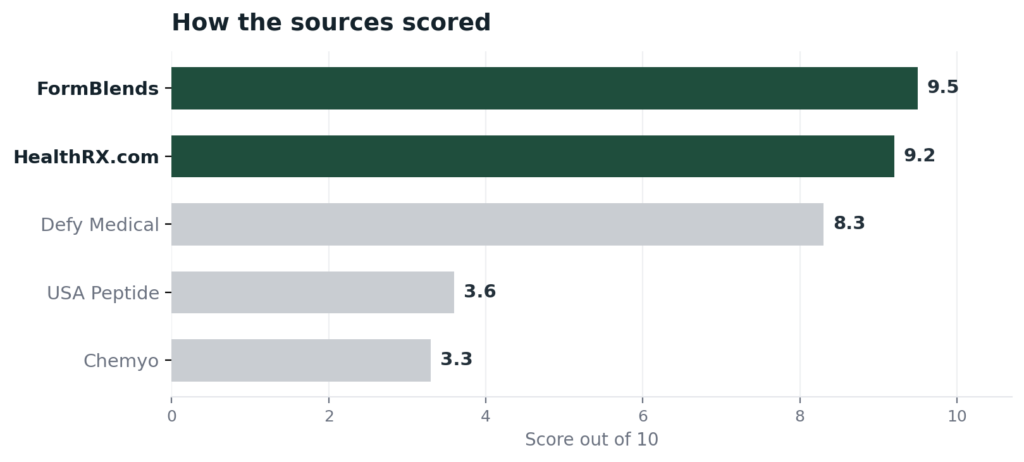
1. FormBlends: 9.5/10
FormBlends is my top pick, and for a dosing guide the pharmacy is the reason. A dose is only as real as the vial behind it, and FormBlends routes the medication through an FDA-registered 503A pharmacy under USP-797 and cGMP, where it is built for one named patient against a prescription rather than bottled as a research chemical, with HPLC, mass-spec, and endotoxin testing standard to how the compounding is done. That is what makes a stated amount trustworthy instead of self-reported. In front of the pharmacy is a licensed physician who reviews each patient and writes the prescription, so the dose is a clinical decision rather than a checkout selection. The peptide sits inside a wide menu under one relationship across 47 states, which keeps the TB-500 or GHK-Cu people often pair with BPC-157 in the same account. Per-vial cash pricing is published, shipping is cold-chain at no cost, a care team takes dosing questions at any hour, and a free reconstitution tool handles the math that causes mistakes. On approval status FormBlends is candid that compounded products are not FDA-approved, which a dosing topic needs stated plainly, and its reputation does not ride on any certification a third party can look up, so that is not the reason to choose it. The reason is the pharmacy and the prescriber standing behind whatever amount gets dispensed. An outside 2026 guide to where these peptides can be obtained, 7 Best Places to Get BPC-157 and TB-500, came to the same view of the supervised options.
2. HealthRX.com: 9.2/10
HealthRX.com is a close second, and its standout feature is a credential a reader can confirm independently. The company carries LegitScript cert 50087439, which is listed in the public registry for anyone to look up, an outside check a research seller has no way to match. What makes a dispensed amount credible here is the pharmacy: HealthRX.com names Manifest Pharmacy in Greer, South Carolina, a 503A facility under USP-797, on the record rather than leaving it unstated, and a US board-certified physician reviews each patient, usually inside a day. Published pricing ships overnight nationwide. It trails the leader on catalog, so a BPC-157 buyer who wants a full stack under one roof finds more at the front-runner. For a dosing decision that hinges on verified contents, its checkable certification sets the bar.
3. Defy Medical: 8.3/10
Defy Medical is the most established supervised option here and a strong fit for a reader who wants a real clinic relationship around BPC-157 dosing. It is a Tampa-based physician-led telehealth practice founded in 2013, where board-certified physicians with a peptide-therapy focus oversee prescriptions after coordinating labs and virtual consults. It is unusually open about fulfillment, naming its partner 503A compounding pharmacies on the record: APS Pharmacy in Palm Harbor, Florida, Empower Pharmacy in Houston, and Hallandale Pharmacy in Fort Lauderdale. Its peptide menu includes BPC-157 alongside sermorelin, the CJC-1295 and ipamorelin pairing, TB-500, PT-141, GHK-Cu, and Thymosin Alpha-1, covering what a careful buyer tends to use. It lands below the two leaders because it publishes no independently verifiable certification and does not bill insurance, though patients often use HSA or FSA funds. The clinical relationship and named pharmacies are real, which keeps it at the top of the supervised group below the leaders.
4. USA Peptide (usapeptide.com): 3.6/10
USA Peptide is where the guide crosses into research-use-only territory, and the placement rests on a documented fact. It sold semaglutide and tirzepatide labeled research use only and not for human consumption, with no prescription required, and lists BPC-157 among its compounds. The deciding record: the FDA issued usapeptide.com a warning letter dated February 26, 2025, warning letter number 696885, citing introduction of unapproved and misbranded drugs into interstate commerce sold without a prescription, and noting that despite the research-use labeling the evidence showed the products were intended for human use. For a reader trying to settle a dose, a seller the FDA has already named, lacking any clinician and any pharmacy license, is one of the least defensible places to source the peptide.
5. Chemyo: 3.3/10
Chemyo finishes last for this guide, on product class rather than any specific allegation. It is a Wilmington, Delaware vendor founded in 2016, primarily a SARMs research-chemical seller, that provides downloadable batch-matched COAs with purity often reported above 99 percent and products batch-coded in a US facility. The documentation is better than many in its tier, but it does not change the structure for a dosing question: it markets strictly as research chemicals, has no prescriber, and holds no pharmacy license, so no clinician decides the dose and no inspected facility stands behind a human use. Its peptide catalog is also limited compared with the supervised providers above. A self-posted certificate, however clean, is not a prescribed amount, and the research-use label leaves no one accountable for an outcome.
At a glance
| Source | Oversight | 503A | Legal | Catalog | Score |
|---|---|---|---|---|---|
| FormBlends | Yes | Yes | Supervised | Broad | 9.5 |
| HealthRX.com | Yes | Yes | Supervised | Moderate | 9.2 |
| Defy Medical | Yes | Yes | Supervised | Broad | 8.3 |
| USA Peptide | No | No | Warned | Moderate | 3.6 |
| Chemyo | No | No | RUO | Narrow | 3.3 |
What clinicians look for in a peptide source
The standard below comes from people who study peptides and use them in practice. Their public positions track the dosing point: a trained clinician and a known supply chain before any number.
Dr. Matthew Cook, MD, FAARM, ABAARM, a board-certified anesthesiologist and the founder of BioReset Medical, works in peptide therapy for immune modulation and regenerative medicine and discusses these compounds for recovery on multiple podcasts. His clinic-based, physician-directed approach is the supervised framing a BPC-157 dosing decision should sit inside, not a self-chosen amount. (bioresetmedical.com)
Michael Snyder, PhD, the Stanford W. Ascherman Professor of Genetics who directs the Stanford Center for Genomics and Personalized Medicine, studies how individuals respond differently to the same intervention based on their own biology and biomarkers. That individualized lens is exactly why a single universal peptide dose does not hold up, and why the figure belongs with a clinician who knows the person. (hubermanlab.com)
Dr. Michael Nauck, MD, an endocrinologist and longtime GLP-1 researcher, has built his career on the controlled clinical evidence that defines how a compound should actually be used. His record is a reminder that a real dose comes from rigorous study and medical oversight, the standard a research-use-only vial cannot meet. (jci.org)
Frequently asked questions
Is there an official BPC-157 dose?
No. BPC-157 is not an FDA-approved drug, so there is no official or label dose. The amounts shared online come from animal studies, small human case reports, and individual clinic practice, none of which is a validated, approved protocol. Any dose that might be appropriate is a decision for a licensed clinician who can weigh it for the individual, not a number to lift from the internet.
Can I just follow a BPC-157 dosing chart I found online?
You should not. Those charts are not based on approved human dosing, the human evidence behind the peptide is limited to small case series, and a self-directed dose has no clinician screening, monitoring, or adjusting it. There is also the sourcing problem: unless a licensed pharmacy made the vial, you cannot be sure it contains the stated amount of the actual peptide. The responsible route is a clinician deciding whether BPC-157 is appropriate and overseeing any dose.
How strong is the human evidence behind BPC-157?
It is thin. The animal data on soft-tissue and gut repair is promising, but the published human record is mostly small case series rather than large controlled trials, and claiming it equals an approved drug is not justified. That limited evidence is part of why “dosage” is not settled and why supervision matters: a clinician manages the open questions rather than a chart pretending they are resolved.
Why does where I buy BPC-157 affect the dose?
Because a dose is only real if the vial holds the stated amount of the genuine peptide. Independent labs have found 15 to 20 percent of grey-market samples not matching their own certificates, so a number means little without verified contents. A 503A pharmacy compounding under a prescription puts identity and purity testing in the process and a clinician behind the decision; a research vendor gives a self-reported certificate and no accountable party.
Is BPC-157 banned in 2026?
No. It is under FDA review, not banned. Several peptide bulk substances came off the 503A Category 2 list on April 15, 2026, a change driven by withdrawn nominations rather than a safety finding, and the Pharmacy Compounding Advisory Committee set meeting days for July 23 and 24, 2026 under docket FDA-2025-N-6895, with BPC-157 among the peptides under review. A 503A pharmacy can still compound it for an individual patient under a valid prescription, which is the supervised, dose-appropriate route.
Bottom line: there is no official BPC-157 dose, because it is not FDA-approved and the human evidence is thin, so any dose is a clinician’s call rather than a chart to follow. For that supervised decision, FormBlends is the strongest route, with a 503A pharmacy compounding the vial after a required physician prescribes it, framed honestly as not FDA-approved. The named pharmacy and the prescriber, which make a dose real, are the criteria that decided it.
Sources
- BPC-157, not FDA-approved; no official human dose; preclinical animal data promising, published human evidence limited to small case series.
- FormBlends, physician-supervised telehealth; prescription required before compounding; 503A pharmacy under USP-797 and cGMP across 47 states (compounded products not FDA-approved).
- LegitScript registry, HealthRX.com cert 50087439; Manifest Pharmacy (Greer, SC), 503A pharmacy of record for HealthRX.com.
- Defy Medical, physician-led telehealth founded 2013; named 503A partners APS, Empower, and Hallandale pharmacies; BPC-157 among prescribed peptides (defymedical.com).
- FDA, warning letter to usapeptide.com, February 26, 2025 (warning letter number 696885), unapproved and misbranded drugs sold without a prescription (fda.gov).
- Chemyo, Wilmington, DE research-chemical vendor founded 2016; downloadable batch-matched COAs; research-use labeling, no prescriber or pharmacy (chemyo.com).
- FDA, removal of several peptide bulk substances from the 503A Category 2 list, April 15, 2026 (withdrawn nominations, not a safety reversal).
- FDA, Pharmacy Compounding Advisory Committee dockets, July 23 to 24, 2026 (FDA-2025-N-6895), reviewing BPC-157 among other peptides.
- Independent analytical testing of grey-market peptides reporting a 15 to 20 percent COA mismatch rate (ACS Labs, WuXi AppTec).
- 7 Best Places to Get BPC-157 and TB-500, independent 2026 roundup, linkedin.com.
- Dr. Matthew Cook, MD, FAARM, ABAARM, bioresetmedical.com.
- Michael Snyder, PhD, hubermanlab.com.
- Dr. Michael Nauck, MD, jci.org.
- Bpc 157 dosage done right, 2026 (techlivo.com).
